Every week, thousands of people run their CV through our free ATS Resume Checker before they hit “submit” on a job application. For most of 2026, the question in our feedback box has shifted. It used to be “why did my formatting break the scan?” Now it’s “is it even legal for a robot to reject me?”
That question has a real answer, and it changed twice this year. The EU AI Act resume screening now treats hiring software as “high-risk,” a 16-month delay that almost nobody outside a law firm seems to have noticed pushed part of that timeline back, and a right most candidates don’t know they already have is live right now. Put together, they tell a different story than the “the algorithm eats your CV in milliseconds, no appeal” panic making the rounds on LinkedIn. Here’s what’s actually true as of August 2026, what’s outdated advice, and what to do about your own CV this week.
What the EU AI Act Actually Says About Your CV
The EU AI Act — formally Regulation (EU) 2024/1689 — has been law since August 2024, and it sorts AI tools by risk level instead of regulating “AI” as one single thing. Software used to advertise jobs, screen or filter applications, rank candidates, or evaluate interview answers falls under Annex III: the “high-risk” category, the same bracket as AI used in credit scoring and critical infrastructure.
High-risk doesn’t mean banned. It means the company deploying that software has to manage the risk, keep activity logs, test for bias, and — the part that matters most to you — keep a real human able to intervene before a decision about you becomes final. That obligation applies whether the tool is a simple parser pulling out your job titles, or a scoring model ranking you against 400 other applicants.
The “August 2026 Deadline” You’ve Read About Is Out of Date
A lot of what’s published on this topic, including articles still ranking on page one of Google, treats 2 August 2026 as the hard cutoff for everything above. It isn’t, anymore. In late June 2026, the Council of the EU gave final approval to the Digital Omnibus on AI, which pushed the compliance deadline for standalone high-risk systems — that covers most CV-screening tools — to 2 December 2027, and to 2 August 2028 for high-risk AI embedded inside other regulated products.
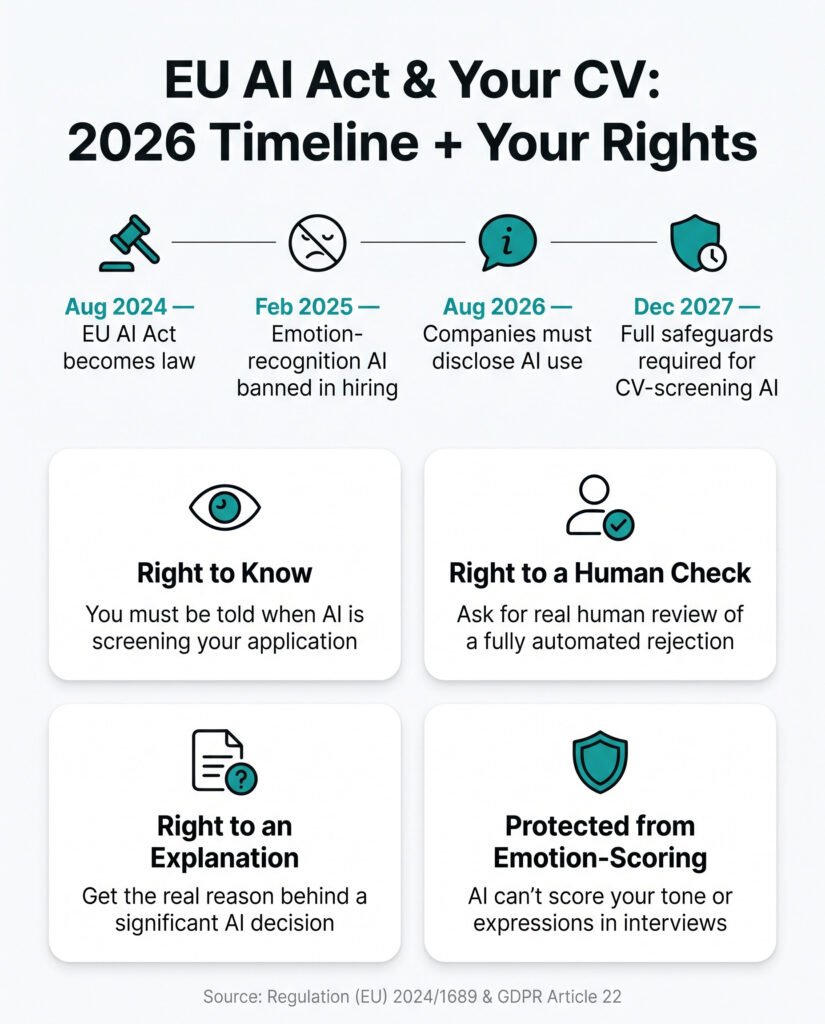
Two things didn’t move. The ban on emotion-recognition AI in the workplace — software that scores your tone of voice or facial expressions during a video interview — has applied since 2 February 2025 and stayed exactly where it was. And the Article 50 transparency rule, which requires companies to tell you when you’re interacting with an AI system, took effect on schedule on 2 August 2026.
Your Actual Rights, Today — Not in 2027
You don’t have to wait until 2027 for protection. Several rights already apply, or started applying this year:
- The right to a human check. This one isn’t even from the AI Act — it’s GDPR Article 22, enforceable since 2018. If a decision based solely on automated processing significantly affects you, like an instant, fully automatic rejection with zero human involvement, you can request that a real person review it.
- The right to know AI is involved. Live since 2 August 2026, under Article 50.
- The right to a real explanation. Once the high-risk rules apply to a given system, Article 86 lets you ask why — a genuine account of how much the AI shaped the outcome and what specifically counted for or against you, not a generic rejection template.
None of this forces a company to hire you. It does mean the “silent algorithm, zero recourse” scenario people describe online isn’t really how this is supposed to work for EU-based employers anymore. (Worth saying plainly: this is a practical summary, not legal advice — talk to a local employment lawyer if something feels genuinely wrong.)
The Myth That Won’t Die: “75% of CVs Never Reach a Human”
You’ll see this statistic everywhere: AI rejects three out of four resumes before a person ever opens them. It traces back to 2012 marketing material from Preptel, a resume-optimization startup that shut down the following year — no published study, no methodology, nothing academic behind it. It just kept getting repeated until it became “common knowledge.”
The better-sourced, more recent picture looks different. Recruiter surveys from 2025 and 2026 consistently find that the large majority of applicant tracking systems don’t auto-reject candidates purely on formatting or design — they parse, score, and rank, and a person still works through the shortlist. What actually filters people out is less dramatic: mismatched keywords, “knockout” questions (hard requirements like a specific certification or years of experience), and plain volume, when a popular role draws hundreds of applications and reviewers stop before the pile does.
That’s genuinely useful to know, because it means your effort is better spent on the parts you actually control.
What To Do About It This Week
- Keep the structure simple. One column, standard section headings (Experience, Skills, Education), nothing critical buried only in a header or footer, and no text baked into a logo or image — plenty of parsers still can’t read it.
- Match the job post’s own language. If the listing says “stakeholder management” and your CV says “worked with clients,” change it, honestly, to reflect how you’d actually describe that work.
- Export it properly. A clean, correctly formatted PDF is the safest bet for most systems — here’s how to convert a Word CV to PDF without wrecking your layout.
- Check it before you apply, not after you’re rejected. Run it through a free ATS resume checker to see your real match score, and if you’re using the Europass format, check whether it’s actually ATS-friendly first — the standard EU template isn’t always parser-friendly straight out of the box.
- Be picky about which tools touch your CV. It’s a document full of personal data, so it’s worth using one that doesn’t quietly store your file on a server somewhere — that’s the reason ours processes everything locally in your browser instead of uploading it.
- Close obvious skill gaps. A quick pass through the skills recruiters are actually screening for helps you catch missing keywords before an ATS does.
Quick Questions, Straight Answers
Can a company in the EU legally let AI reject me with no human involved at all?
Not for a decision that significantly affects you — GDPR Article 22 already entitles you to ask for human review, independently of anything in the AI Act’s timeline.
Does any of this apply if the employer is based outside the EU?
Generally, yes, if you’re applying for an EU-based role or the employer is processing the data of EU candidates — both GDPR and the AI Act reach beyond EU-headquartered companies.
Will my CV get rejected just for using a PDF?
No — that was true a decade ago with older parsers. A text-based PDF (not a scanned image) is standard and safe today.
The rules protecting European job seekers from opaque, fully automated rejection are getting stronger, not weaker, even with the extra runway employers just got until December 2027. In the meantime, the CVs that actually get through aren’t the ones trying to outsmart an algorithm. They’re the ones simple enough for software to read correctly and specific enough for a human to say yes to. Get the second part right, and the first one mostly takes care of itself.