
If you’ve sent out a stack of Europass CVs this year and heard almost nothing back, you’re not imagining things — and it’s probably not your experience that’s the problem.
We build resume tools for a living, so when a few readers wrote in asking why their “perfectly filled” Europass CV wasn’t getting past the first stage, we did the obvious thing: we pulled a handful of real Europass CVs, ran them through our own ATS checker plus a couple of others, and watched what actually happened field by field. Some of what we saw was worse than expected. Some of it was an easy fix. Here’s the honest breakdown, and what to do about it.
What a Europass CV Is (and Why It’s Everywhere in Europe)
The Europass CV is the standardised résumé format the EU rolled out in the early 2000s so a hiring manager in Lisbon and one in Helsinki could read a candidate’s qualifications the same way. It has a fixed structure — personal details, work experience, education, skills, often a language grid, sometimes annexes — and it genuinely does the job it was built for: comparing people across borders for institutional, academic, and public-sector purposes.
The problem is that most people now use it as their only CV, for every application, including private-sector jobs that run on commercial hiring software with completely different rules. That’s where things start going sideways.
We Ran Real Europass CVs Through ATS Software. Here’s What Broke.
An Applicant Tracking System doesn’t read a CV the way a person does. It extracts text, tries to sort it into fields, and scores what it finds against the job description. When it can’t confidently sort something, it drops it or buries it — and it never tells the candidate why. For context, our own checker page puts ATS software at the front of over 75% of hiring pipelines, and that lines up with most 2026 hiring surveys, several of which put adoption among large employers closer to 90–99%.
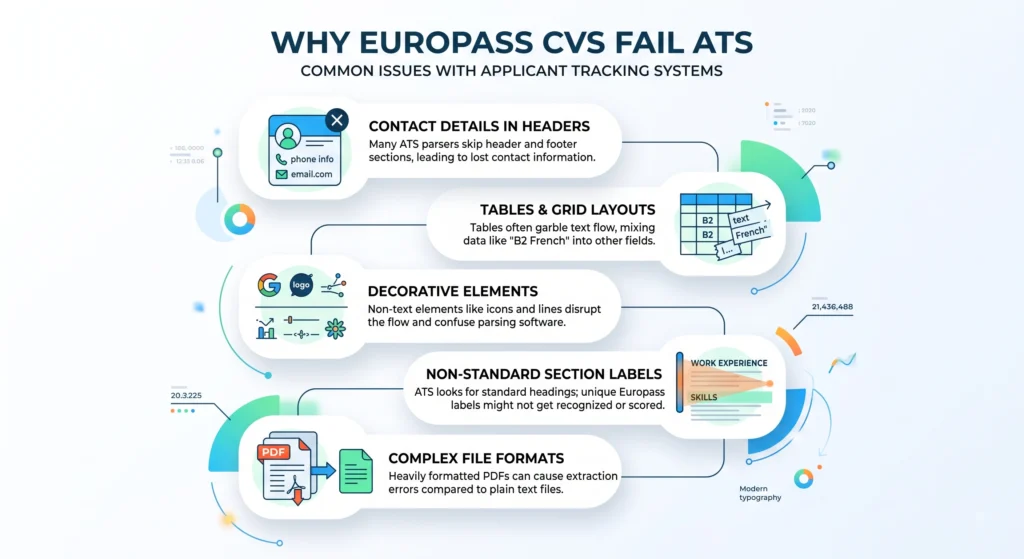
Here’s what consistently tripped things up when we tested Europass exports:
- Contact details in the header. Europass places your name, phone, and email in a header block. Plenty of parsers skip headers and footers entirely, so the system technically has your CV but no reliable way to identify or reach you.
- Tables and grid layouts. The language self-assessment table and any boxed sections look fine to a human eye, but several parsers pulled the text out in the wrong order or merged it into one garbled block — occasionally stitching “B2 French” into the middle of a job title.
- Decorative elements. Logos, dividing lines, and small icons don’t just get ignored; depending on the parser, they can break the text flow running around them.
- Non-standard section labels. ATS software is tuned to recognise headings like “Work Experience” or “Skills.” Europass’s own phrasing doesn’t always map cleanly, which can mean an entire section gets scored as empty.
- The file itself. A Europass CV exported as a heavily formatted PDF from the online builder is far more likely to cause extraction errors than a plain .docx. Older systems in particular choke on it.
- Personal fields that add zero keyword value. Date of birth, nationality, and a photo eat up space, and in several EU countries employers are now actively discouraged from requesting them anyway — yet they’re still default fields in Europass.
None of this means Europass is badly designed. It was built for humans and institutions, not keyword-matching software. That’s a different job entirely.
Europass CV vs. an ATS-Tailored CV
| Europass CV | ATS-Tailored CV | |
|---|---|---|
| Structure | Fixed, same order for every application | Reordered to lead with what matches the job |
| Typical length | Often 3–5 pages once fully filled in | 1–2 pages, dense with relevant content |
| Tables & graphics | Language grid, boxed layout, logo | Plain text, no tables or icons |
| Keyword match | Generic, not tailored per posting | Mirrors the actual job description |
| Best used for | EU institutions, Erasmus+, academia, some public-sector roles | Private sector, international companies, most online applications |
When You Should Actually Keep Using Europass
We’re not telling you to delete it. If you’re applying to the European Commission, an EU agency, an Erasmus+ programme, a scholarship, or a public-sector role in a country where Europass is still the expected norm (common across Southern and Eastern Europe), keep it and use the official format — deviating in those specific cases can genuinely work against you. It’s also worth knowing that Europass isn’t standard in the UK; UK recruiters generally expect a traditional CV instead.
The mistake is using it as your one and only CV for private-sector applications too. That’s the version worth fixing.
The Fix: Turning Your Europass Content Into an ATS-Safe CV (About 20 Minutes)
You don’t need to rewrite your career history. You’re repackaging the same information into a shape software can actually parse.
- Open a blank document, not the Europass template. Start clean in Word or Google Docs — single column, no borders, no text boxes.
- Move your contact details into the body. Name, phone, email, city, and LinkedIn go at the very top of the page itself, never in a header or footer.
- Rebuild the language and skills grid as plain text. Instead of a table, write it out: “French — C1, German — B2, conversational Italian.” Same information, none of the parsing risk.
- Rename your sections. Swap Europass’s own phrasing for the standard labels ATS software is trained to look for: Work Experience, Education, Skills, Certifications.
- Cut what doesn’t earn its place. Date of birth, nationality, marital status, and a photo can usually go, unless the specific market or role expects them.
- Mirror the job ad’s language. If the posting says “stakeholder management” and you wrote “worked with clients,” change it. ATS scoring is largely keyword matching against the exact posting, not a general skills summary.
- Save it as a clean .docx for online portals, and keep a nicely designed PDF version for emailing directly to a person.
- Check it before you send it. Run the finished file through a proper ATS checker so you’re not guessing. Our own ATS Resume Checker and Builder scores the document, flags exactly which sections aren’t parsing cleanly, and can match it against a specific job description — and because it runs without an account, you’re not signing up somewhere new just to see one score. For the fuller background on how ATS scoring works in general, we’ve broken that down separately in our ATS resume checker guide. And if you’re stuck on what actually belongs in that skills section, this list of skills employers respond to is a solid place to start.
If your finished application also needs certificates or a cover letter bundled in, merge everything into one PDF rather than sending five separate attachments. And if a portal rejects your file for being too large — which happens more than it should on older EU government and university application systems — running it through a free PDF compressor usually fixes it in seconds without visibly hurting quality.
The Part Most Guides Skip: Where Does Your CV Data Actually Go?
This matters more in Europe than most places, and it’s worth a paragraph of its own. A CV is a document full of personal data under GDPR — your name, address, work history, sometimes your date of birth and a photo. When you drop it into a random “free ATS checker” online, that file is very often uploaded to a server, sometimes stored, sometimes tied to an account you just created without reading the privacy policy.
If you’re going to check your CV against a tool before you’re happy with it — and we’d genuinely recommend doing that — it’s worth knowing whether that tool is storing your file afterwards. It’s part of why our own checker processes everything without requiring your file to sit on a server or an account to be created first. For a document carrying this much personal information, that shouldn’t be a lot to ask.
If you still need a compliant photo for the specific roles where one’s expected, resize it to the right dimensions first with a free photo resizer rather than uploading it somewhere just to crop it.
Quick Answers
Is a Europass CV ATS-friendly?
It’s parseable, in that ATS software can usually extract the text. It’s not optimised, because the fixed structure doesn’t let you prioritise the keywords and achievements a specific job needs. Readable and optimised aren’t the same thing.
Do UK employers accept Europass CVs?
Generally, no. It isn’t the expected format in the UK, and a traditional CV will read more naturally to a UK recruiter.
Should I include a photo on my CV?
For most private-sector and international applications, leave it off. Several EU countries actively discourage it to reduce hiring bias, and it gives an ATS nothing useful to work with. Keep it only where a specific market or role expects one.
How long should a European CV actually be?
One page if you’re early career, two if you have real experience behind you. Three-plus pages is really only appropriate for academic or research CVs.
Can I keep both versions?
Yes, and you probably should. Keep the official Europass CV ready for EU institutions or academic applications, and a separate ATS-tailored version for everything else.
Where This Leaves You
A Europass CV isn’t broken, and it wasn’t a waste of the time you spent filling it in — it’s just doing a different job than the one most people ask it to do. Keep it for the institutional and academic applications it was built for, and build a second, plainer version for everything running through commercial hiring software. Twenty minutes of formatting is a small trade for actually reaching a recruiter’s screen. If you want to see exactly where your current CV stands before you send it out again, run it through our free ATS checker — no account, no file sitting on a server, just a straight answer.