A ChatGPT cover letter takes about a minute to generate. Making it sound like a real person applying for this exact job takes a little longer, and that second part is what recruiters actually notice.
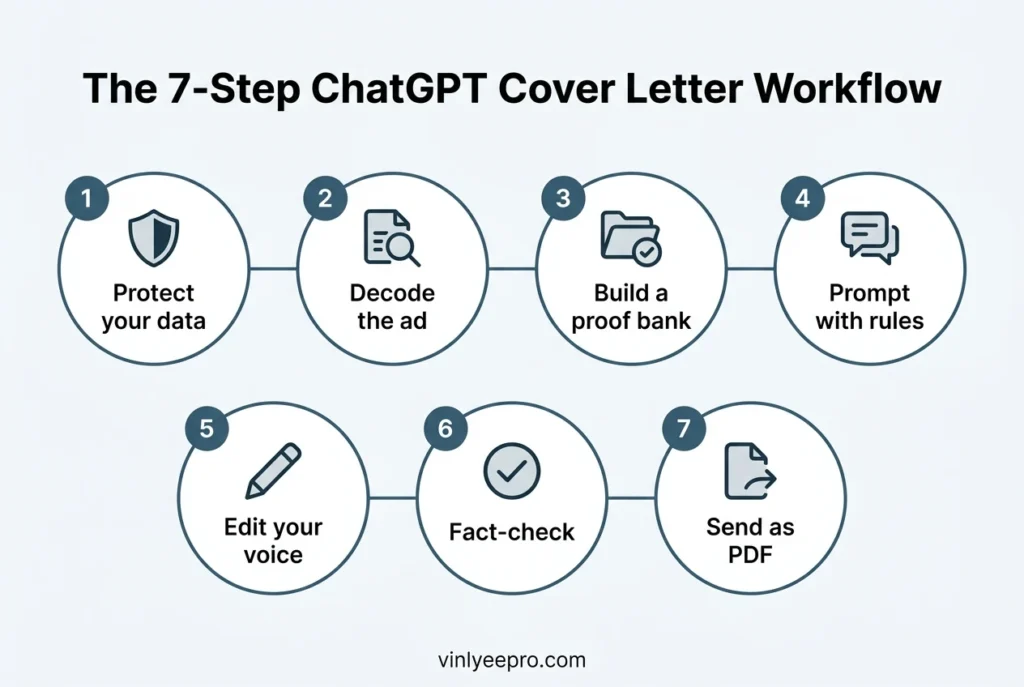
Most people paste a job ad into the chat, accept the first draft and hit send. The result is smooth, polite and interchangeable with hundreds of other letters. This guide fixes that with seven steps, a copy-ready prompt, recent survey data from Europe and the US, and a privacy step most guides skip.
Do recruiters still read cover letters, and do they mind AI?
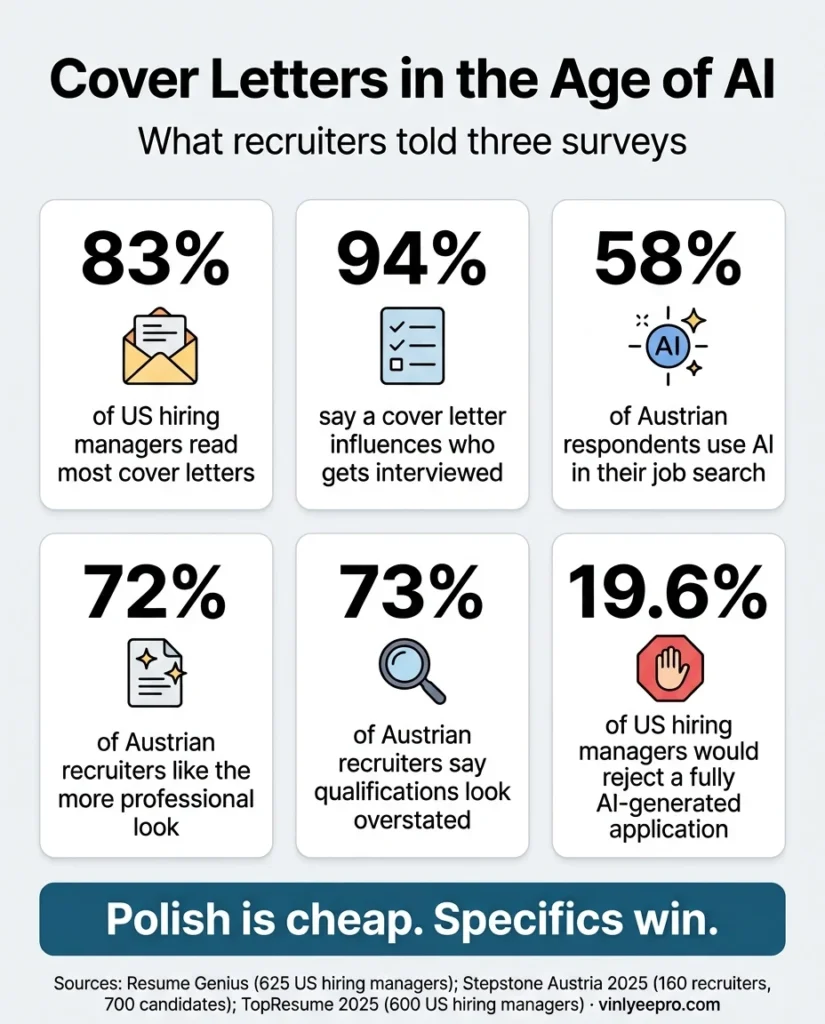
Yes to the first. In a Resume Genius survey of 625 US hiring managers, 83% said they read most of the cover letters they receive, and 94% said the letter influences who gets an interview. Nearly half (49%) said a strong letter can win an interview for a candidate with a weaker CV.
The AI question is more nuanced. A Stepstone study in Austria (160 recruiters, 700 candidates) found that 58% of respondents use AI in their job search and applications, including for documents like the cover letter. Recruiters liked the cleaner look (72%), but said applications feel less tailored (63%) and less authentic (68%), and 73% said qualifications seem overstated. In the US, a TopResume survey of 600 hiring managers found that 19.6% would reject an application that looks fully AI-generated, while 52% accept AI help with proofreading or drafting. stepstonetopresume
The pattern is consistent. Recruiters aren’t objecting to the tool. They’re objecting to letters with no specifics and inflated claims.
About the numbers: these are self-reported surveys from different countries, so read them as direction, not law. A few widely repeated “X% can spot AI” figures were left out because they couldn’t be traced to their supposed source.
Step 1: Protect your data before you paste anything
Your CV is personal data, and a chatbot only needs your skills and results, not your address. Remove your phone number, email, street address and any ID numbers first. University career services give the same advice: paste bullet points and skills, and leave the contact header out.
Then check your settings. OpenAI’s help page explains that switching off “Improve the model for everyone” under Settings, then Data Controls, keeps your chats out of model training, although they still show in your history. Temporary Chat is another option for one-off drafts; check OpenAI’s help page for how long those chats are kept. openai
Step 2: Decode the job ad and pick three hard skills
Paste the job description and ask ChatGPT to sort the requirements into essential and preferred, then into hard skills and soft skills. Hard skills are the provable ones: tools, methods, certificates and languages. Typical hard skills examples include data analysis, SEO, Excel, bookkeeping, project management software and a second language, plus certificates such as first aid. For a security guard resume and cover letter, think CCTV monitoring, access control and incident reporting.
Why the focus? In the Stepstone study, missing relevant skills was the most common reason for early rejection (71%), followed by a lack of specific experience (55%). Pick the three hard skills the ad mentions most and prove each in a sentence or two. Career advice sites agree: use the letter to reinforce two or three key skills and say what came of them. stepstoneexec
Use this prompt first:
Here is a job description: [paste it]. List the five most important requirements. Mark each as a hard skill or soft skill, and as essential or preferred. Don’t write anything else.
Step 3: Build a proof bank (the part ChatGPT can’t do)
For each of your three skills, write two or three true facts: what you did, with which tool or method, and what changed. Numbers help when they’re real. “Cut invoice errors by about a third by adding a second check in Excel” is a usable line. “Excellent attention to detail” isn’t. No number? Use a concrete detail instead, such as “Covered the front desk during two fire drills and wrote both incident reports.” (Both are made-up examples.)
This step also keeps you honest. Overstated qualifications drew the most complaints in the Stepstone results (73%), and ChatGPT will happily add achievements you never had.
Step 4: Use a ChatGPT cover letter prompt with rules, not just a request
A bare “write me a cover letter” gets you the generic version. Give ChatGPT your facts, a length limit, a ban list and one last job: auditing its own work.
You are helping me write a cover letter. Use ONLY the facts I give you. Do not invent achievements, numbers, tools or details about the company. If something is missing, ask me.
Role and company: [ ]
What the company cares about (from its site or the ad): [ ]
Top three requirements: [ ]
My proof for each (true facts only): [ ]
Why this job, in my own words: [ ]
Rules: 250-300 words, three short paragraphs, plain language, no phrases like “passionate team player”. The first sentence must mention something specific to this company. End with one concrete next step.
After the letter, list every claim that isn’t backed by the facts above.
That last line is the trick. It makes ChatGPT flag its own inventions before you have to hunt for them.
Step 5: Edit until it sounds like you
Read the draft aloud and look for the usual tells: a grand opening that could start any letter, buzzwords with nothing behind them, the job ad repeated back to the employer, nothing specific to this company, and prose so even it has no personality.
Then rewrite the opening and the closing yourself, because those are the parts readers remember. Here’s a made-up example for a night-shift security role:
| Generic draft | Edited version |
|---|---|
| “I am writing to express my strong interest in the Security Officer position at Northgate Retail.” | “Two doors were left unlocked on my night shift last winter. I rewrote the closing checklist, and it hasn’t happened since. That’s the kind of detail I’d bring to Northgate.” |
Vary your sentence length, cut anything you couldn’t say to the hiring manager’s face, and keep one detail only you would know.
Step 6: Fact-check and trim
ChatGPT can state invented details with total confidence, and it doesn’t always respect your word count. Check every name, date, number and tool against your CV and the job ad. Then trim. The Resume Genius survey points to PDFs and letters of around 400 words at most, so 250 to 350 words on one page is a safe target.
Step 7: Package it properly
Save the letter as a PDF with a clear name, like Firstname-Lastname-Cover-Letter.pdf. If the portal takes one upload, merge the letter and CV with our free Merge and Split PDF tool; it runs in your browser, so nothing is uploaded to a server. If the application asks for a photo, which is still common in some European countries, the Photo Resizer sets exact dimensions in millimetres or centimetres.
Writing an ansøgning? Adapt the workflow for Europe
In Denmark the cover letter is an ansøgning, and the job portal Jobindex advises one page: say why you want this particular job, match your skills to the company’s needs, back claims with concrete examples and skip the clichés. That lines up with the workflow above. If you ask ChatGPT to write in another language, put the length limit and tone in the prompt, then have a native speaker check it, because literal translations of English openers often read stiffly.
After the letter: practise the interview question it invites
Every claim in your letter can become an interview question. Guides written for recruiters suggest testing a written claim by asking for the story behind one achievement. Open a fresh chat, paste your final letter and the job ad, and try: “Act as the hiring manager. Ask me five interview questions that test specific claims in this letter, one at a time, and push back if I’m vague.” Practise out loud. Still hunting for roles? Our guide to automating a LinkedIn job search with Claude and Apify helps you shortlist jobs first
Quick Answers
Can employers tell if I used a ChatGPT cover letter?
Some say they can. In TopResume’s test, about a third of hiring managers (33.5%) correctly picked out AI-written resumes, and AI detectors aren’t reliable proof. Recruiters mostly criticise generic, overstated writing, so specific, checked details protect you best
Is it okay to use ChatGPT for a cover letter?
Just over half of hiring managers accept help with drafting and proofreading (52% in TopResume’s survey) if the result sounds human and reflects you. About one in five would reject a fully AI-generated application, so edit it and check the employer’s rules.
How long should a cover letter be?
Aim for 250 to 350 words on one page. In Denmark, one page is the standard advice.