
When I rebuilt VinlyeePro’s ATS Resume Checker earlier this year, I pulled out the OpenAI dependency it used to run on and rebuilt the whole thing to work entirely in the browser — Tesseract.js handling the OCR, a set of regex patterns doing the parsing, and a deterministic scoring model underneath, with nothing sent to a server. Once you’re the one writing the code that reads a CV, you stop repeating advice you’ve seen elsewhere and start knowing what actually happens to a file. And the question I got asked more than almost any other while testing it, mostly from people applying to jobs outside the UK, was some version of: can I put a photo on my CV, or will the ATS just bin it?
The honest answer is narrower than most of the advice floating around online. It depends on where the photo sits on the page, not on whether it exists at all.
What an ATS Actually Does With an Image
An Applicant Tracking System doesn’t “look” at a CV the way a person does. It runs the file through a parser that pulls the text out and slots it into fields — name, email, job titles, dates, skills — much like a form filling itself in. A photo isn’t text, so a parser built to extract text has nothing to do with it. In most modern systems, an image sitting on its own in a single-column layout simply gets skipped. It isn’t rejected or penalised. It’s invisible, the same way a decorative line or a border would be.
Where photos actually cause damage is almost always about the layout they arrive with, not the image itself. Three patterns come up constantly:
- The photo forces a two-column template, and the parser reads left to right across each row instead of down each column, so your skills list and your job history get stitched together into nonsense.
- The photo sits inside a header or footer, which a lot of parsing engines ignore by design, and if your name and phone number are anchored next to it, they get ignored too.
- The whole CV was exported as a flattened image, a common side effect of saving a design-heavy template as a “print quality” PDF, which means there is no text layer at all, photo or not.
A specific number gets repeated across a lot of CV advice, something like 88% of CVs with a photo get auto-rejected. I went looking for where that figure actually comes from while researching this piece and couldn’t find a source that holds up, so I’d rather say that plainly than repeat it as fact. What building a parser actually teaches you is simpler: the photo is the passenger, the layout is the car.
Europe Isn’t One Rulebook
This is where “just take the photo off,” which is correct advice for the US, UK, and Ireland, turns into bad advice the moment you’re applying somewhere else in Europe.
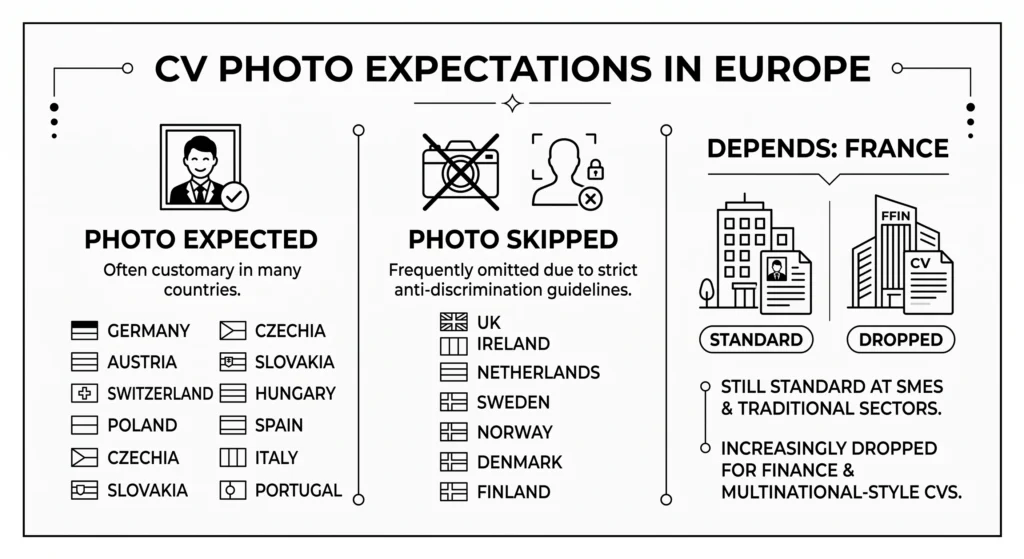
Anglophone markets moved away from CV photos largely for anti-discrimination reasons: a photo introduces age, gender, and ethnicity signals that employment law wants kept out of an initial screening. The DACH region and much of Central and Southern Europe never adopted that convention, so a CV without a photo there can genuinely read as unfinished rather than modern. Neither approach is more correct. They’re answering different questions.
Widely cited industry estimates put the share of mid-size and large European employers now screening applications through some form of ATS somewhere between 60% and 90%, depending on the sector, with public-sector and enterprise employers toward the higher end. That’s a wide margin of applications riding on formatting choices alone.
Getting the Photo Itself Right
If you’re applying somewhere a photo is expected, the format matters more than most candidates assume:
- 35×45mm is the standard across most of Europe, which works out to 413×531px if you’re working digitally at 300 DPI
- Germany often runs slightly larger, closer to 4.5×6cm
- Plain, light background, head and shoulders, placed top-right of the first page, and never dropped inside a text box or table cell, since those are exactly the containers parsers struggle with
While building the preset system on our own Photo Resizer for government exam and ID-style photos, the mistake I saw most often wasn’t photo quality. It was people uploading a personal headshot to some random online cropping site just to hit these dimensions. That’s a photo of your face sent to a server you know nothing about, which is worth a second thought under GDPR before it goes anywhere. The Photo Resizer and Basic Image Editor on VinlyeePro do the cropping and resizing entirely on your device, so the file never leaves your browser before it lands on your CV. Run the result through Image Compressor afterward, and your finished CV stays light enough that older parsing software won’t choke on the attachment.
You don’t need a completely different CV for every country. Keep one master document with your experience and skills, and treat the photo, along with details like date of birth or marital status, as a swappable module rather than something baked permanently into the file. Duplicate it, drop the photo in or take it out depending on where the job is, save the copy under its own filename, and check that version on its own. It takes a few extra minutes per application and stops you from accidentally sending a Dutch employer the same file you built for a German one.
Test It, Don’t Guess It
Once the CV is assembled, photo included or not, the only real way to know how a parser will read it is to run it through one rather than trust formatting advice written for a different country. That’s the entire reason the ATS Resume Checker exists: drop in the finished file and see exactly what gets extracted before you send it anywhere.
One CV, adapted per country, checked before it goes out. The photo was never really the question. Whether it survives contact with a parser is.